
All Things Moon Water
Moon water is often described as something you “make,” but in practice, it’s closer to something you leave out and receive back.
At its most basic, moon water is just water that has been exposed to moonlight. No additives, no required ritual, no fixed outcome. The process is simple enough that it resists embellishment. What matters is not what is done to the water, but when and where it is placed.
Like many things in folk practice, its meaning comes from context.
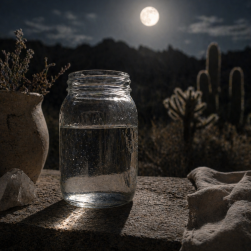
History of Moon Water
Moon water, as is understood today, does not have a single, traceable origin and is a fairly modern practice. According to Briana Saussy, “The first documented mention of Moon water comes from the 1860s, and it was interestingly in a Christian context. Most likely, water set out under a Full or New Moon has been worked within folk magic traditions much longer.”
What can be traced more clearly is the belief behind it. Classical sources like Natural History describe the moon’s influence on tides, moisture, and plant life; reflecting a long-standing association between lunar cycle and the natural world.
The modern, recognizable version of water appears distinctly in the late 20th-century texts, including The Complete Book of Incense, Oils, and Brews (1988), where a preparation called Moon Brew outlines the modern practice.
Moon water, in its current form, is best understood as a modern synthesis….rooted in older observations, but shaped into a defined practice relatively recently.
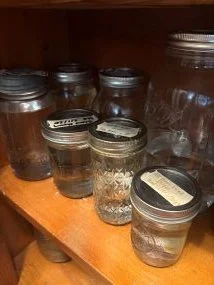
Not Inherently Magical
Moon water is frequently framed as a tool for manifestation or intention-setting. That language exists, but it’s not universal, and it’s not necessary. In quieter traditions, moon water is not treated as a substance that does something. It’s not charged, activated, or transformed in a dramatic sense. It is simply water that has been exposed to a cycle larger than itself.
Its significance comes from:
the phase of the moon
the astrological sign of the lunar cycle
and the reason it was set out, if there was one at all
Without that context, it’s just water. And that’s part of the point.
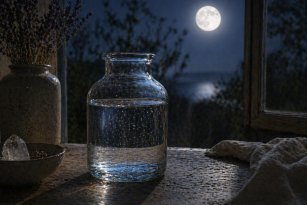
Timing Matters
The moon moves through phases that mark time more than they dictate outcome. Moon water follows that same logic.
Full moon: often associated with completion and release
New moon: associated with new beginnings
Waxing and waning phases: subtle shifts, not hard directives
The water reflects the conditions it was exposed to. As a note: Some people strongly caution against making Moon water during an eclipse. However, some choose to ignore this advice, claiming the eclipse water can be potent. In some practices, and how I work with moon water, is to set out water during a full moon associated with the astrological sign the moon is moving through.
For example,
A moon in Libra may bring attention to balance, relationships, or where things feel uneven
In Virgo, to refinement, habits, or what needs adjusting
In Taurus, to stability, comfort, or what is being sustained
In Scorpio, to intensity, privacy, or what’s held below the surface
These aren’t rules, and they don’t assign outcomes. They describe the quality of the moment the water was left out in.
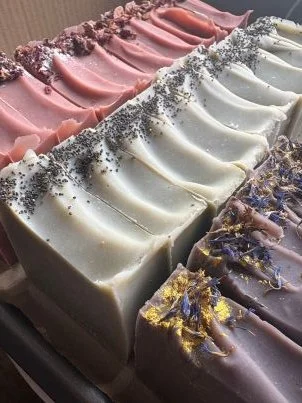
Heart + Lore Moon Water Soap
Uses
Moon water is often used in ways that are quiet and functional:
added to a bath
incorporated into existing routines or skincare products
to charge crystals
or simply kept
There is no requirement to assign it a purpose. In some cases, it’s never used at all. It simply exists as a record of a specific night.
